Grounding / Earthing Mats
Home Environment · Devices
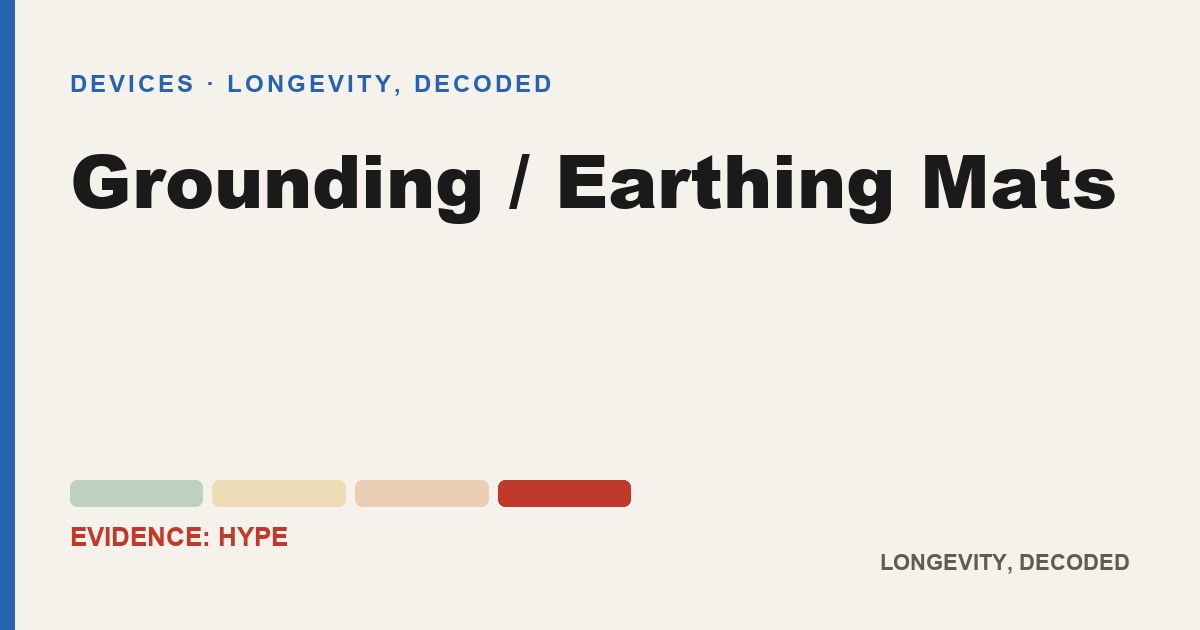
Evidence rating: Thin / Hype. Little or no human evidence; popular mostly on testimonials.
Grounding is cheap and mostly harmless, and if relaxing on a mat helps you wind down, there's no harm in that. But the dramatic health claims aren't backed by solid human evidence. Treat it as a relaxation ritual, not a medical tool, and if you want the real thing, walking barefoot outdoors is free.
What is Grounding / Earthing Mats?
A grounding (or “earthing”) mat is a conductive pad you sit on, stand on, or sleep against, connected by a wire to the ground port of an electrical outlet or a rod stuck in the soil. The premise is that it electrically connects your body to the earth, the way walking barefoot on grass or sand would, so that you can absorb the earth’s electrons indoors.
What does Grounding / Earthing Mats claim to do?
Proponents claim grounding reduces inflammation, relieves pain, improves sleep, lowers stress, balances the nervous system, thins the blood, speeds recovery, and reduces the effects of “everyday electromagnetic exposure.” The unifying theory is that free electrons from the earth act as antioxidants that neutralize inflammation throughout the body.
Why do people use Grounding / Earthing Mats?
The story is intuitive and appealing: modern life keeps us insulated from the earth by shoes and floors, so reconnecting feels like correcting an unnatural deficit. It’s cheap, requires no effort, and is wrapped in a back-to-nature narrative. A handful of small studies and a lot of enthusiastic testimonials keep it circulating in wellness circles.
What does the science actually say about Grounding / Earthing Mats?
This is one to be honest about: the human evidence is weak. The research that exists is dominated by small studies, often with few participants, frequently conducted or co-authored by people connected to the grounding industry, and rarely well-blinded. That combination makes it hard to separate a real effect from placebo and bias.
Some of these small studies report changes in things like sleep quality, subjective pain, or certain blood markers. But the studies are too few, too small, and too methodologically shaky to support the sweeping claims made for the products. There is no large, independent, well-controlled body of human research showing that grounding mats produce the benefits advertised. The underlying “electron transfer” mechanism is also more asserted than demonstrated in living humans.
None of this proves grounding does nothing, sitting still and relaxing for half an hour can genuinely feel good, and placebo effects on sleep and pain are powerful and real. But the honest position is that the proof simply isn’t there, and the gap between the confident marketing and the actual evidence is wide.
How do people use Grounding / Earthing Mats?
People use a mat for anywhere from 30 minutes to several hours a day, often while working at a desk or sleeping. Mats connect either to the grounding pin of an outlet (in homes with proper grounded wiring) or to a rod placed in outdoor soil. Some prefer simply going barefoot outdoors, which costs nothing.
Is Grounding / Earthing Mats safe? Risks and who should skip it
Grounding mats are generally low-risk, but there’s a real electrical-safety caveat: connecting your body to faulty house wiring is not something to do casually, and people with pacemakers, on blood-thinning medication, or with other medical devices should check with their doctor first, since some grounding claims involve effects on blood and clotting. Don’t let a mat replace evidence-based steps for sleep or pain.
The bottom line on Grounding / Earthing Mats
Grounding is cheap and mostly harmless, and if relaxing on a mat helps you wind down, there’s no harm in that. But the dramatic health claims aren’t backed by solid human evidence. Treat it as a relaxation ritual, not a medical tool, and if you want the real thing, walking barefoot outdoors is free.
Frequently asked questions about Grounding / Earthing Mats
Does Grounding / Earthing Mats actually work?
The claims are big, the mechanism is unproven in humans, and the supporting studies are small, biased, and few, popularity rests mostly on testimonials.
Is Grounding / Earthing Mats safe?
Grounding mats are generally low-risk, but there's a real electrical-safety caveat: connecting your body to faulty house wiring is not something to do casually, and people with pacemakers, on blood-thinning medication, or with other medical devices should check with their doctor first, since some gr
How do people use Grounding / Earthing Mats?
People use a mat for anywhere from 30 minutes to several hours a day, often while working at a desk or sleeping. Mats connect either to the grounding pin of an outlet (in homes with proper grounded wiring) or to a rod placed in outdoor soil.
Related in Devices
Medical disclaimer: This article is for general information only and is not medical advice, a recommendation, or an endorsement. Nothing here is intended to diagnose, treat, cure, or prevent any disease. Talk to a qualified healthcare professional before changing anything you do. See our full disclaimer.