Epitalon
Immune, Gut & Cellular Aging · Peptides
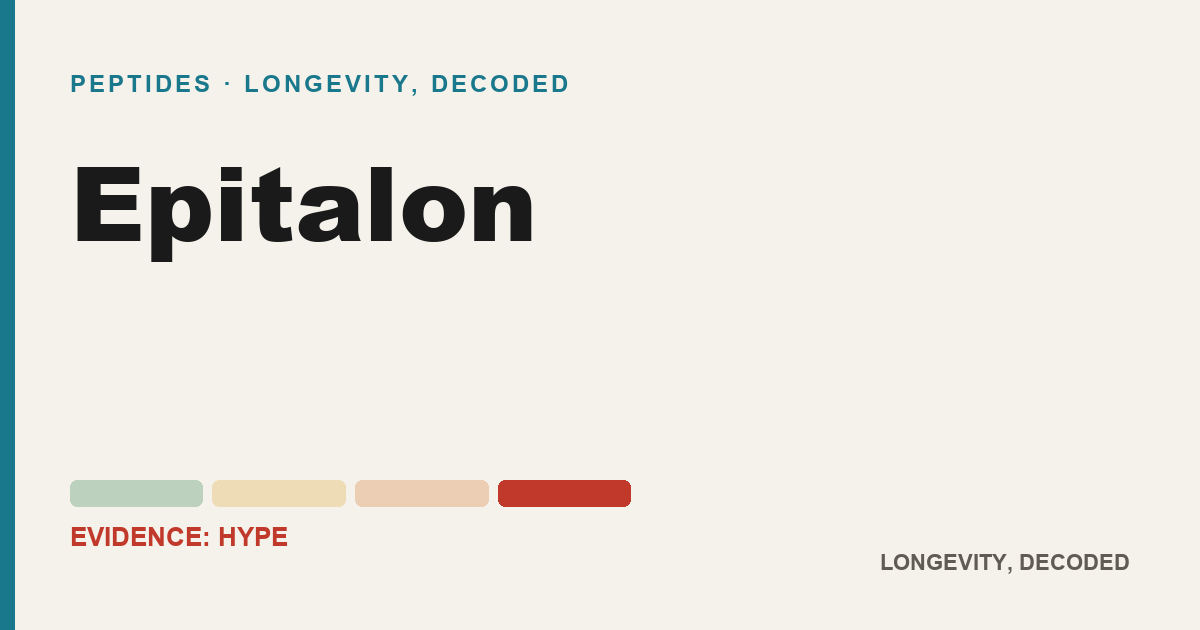
Evidence rating: Thin / Hype. Little or no human evidence; popular mostly on testimonials.
Epitalon makes some of the boldest anti-aging promises in this book on some of the thinnest independent evidence. The mechanism is interesting and the marketing is seductive, but the science simply isn't there yet, and the cancer-related caution is real.
What is Epitalon?
Epitalon (also spelled Epithalon) is a tiny synthetic peptide, just four amino acids, developed in Russia decades ago. It is a lab-made version of a substance derived from the pineal gland, a pea-sized gland in the brain that helps regulate sleep and daily rhythms. Epitalon is a Russian-origin research peptide. It is not FDA-approved in the United States and is not an approved medicine in most of the world; nearly all of its human research comes from a small group of Russian investigators.
What does Epitalon claim to do?
Epitalon carries some of the boldest claims in this entire book:
- Lengthens telomeres, the protective caps on the ends of your chromosomes that shorten as cells age
- “Resets” the body’s aging clock
- Extends lifespan
- Improves sleep and restores pineal-gland rhythms
Why do people use Epitalon?
Telomeres are catnip for the longevity crowd. The idea that a cheap four-amino-acid peptide could lengthen them, and that old Russian studies reported longer survival in treated animals and even elderly patients, is irresistible. It has become a flagship “anti-aging” peptide on forums precisely because the promise is so dramatic.
What does the science actually say about Epitalon?
Here honesty matters most. The dramatic claims rest almost entirely on a narrow body of Russian research, much of it decades old, often from the same institute, and rarely replicated by independent labs elsewhere. Some of these reports describe longer lifespan in animals and improved markers in elderly people. That sounds remarkable, but findings that have not been reproduced by outside researchers, under modern standards, cannot be treated as established.
The telomere claim deserves special scrutiny. Lab studies suggest Epitalon can influence telomerase, the enzyme that maintains telomeres. But “affects an enzyme in cells” is a very different thing from “safely makes humans age slower or live longer.” Independent, large, modern human trials confirming any anti-aging benefit do not exist. And telomere lengthening is not a free lunch: telomerase activity is also a feature of cancer cells, which is one reason researchers urge caution rather than enthusiasm.
In plain terms: the mechanism is intriguing, the original reports are bold, and the independent confirmation is missing.
How do people use Epitalon?
In the experimental community it is used in injected “courses” lasting a couple of weeks, sometimes repeated a few times a year, with doses reported in the older literature. None of this constitutes a validated protocol, and this book does not provide sourcing or self-administration guidance.
Is Epitalon safe? Risks and who should skip it
Long-term safety in humans is essentially unknown, which alone is reason for caution. The theoretical link between telomerase activation and cancer growth means anyone with a personal or strong family cancer history should be especially wary. Pregnant or nursing people, and anyone on medication, should not use it without a physician’s involvement. Purity of unregulated peptides is a recurring concern.
The bottom line on Epitalon
Epitalon makes some of the boldest anti-aging promises in this book on some of the thinnest independent evidence. The mechanism is interesting and the marketing is seductive, but the science simply isn’t there yet, and the cancer-related caution is real.
Frequently asked questions about Epitalon
Does Epitalon actually work?
The dramatic anti-aging and telomere claims come from a small, mostly unreplicated foreign research base, with no robust independent human trials.
Is Epitalon safe?
Long-term safety in humans is essentially unknown, which alone is reason for caution. The theoretical link between telomerase activation and cancer growth means anyone with a personal or strong family cancer history should be especially wary.
How do people use Epitalon?
In the experimental community it is used in injected "courses" lasting a couple of weeks, sometimes repeated a few times a year, with doses reported in the older literature. None of this constitutes a validated protocol, and this book does not provide sourcing or self-administration guidance.
Related in Peptides
Medical disclaimer: This article is for general information only and is not medical advice, a recommendation, or an endorsement. Nothing here is intended to diagnose, treat, cure, or prevent any disease. Talk to a qualified healthcare professional before changing anything you do. See our full disclaimer.