Pinealon
Immune, Gut & Cellular Aging · Peptides
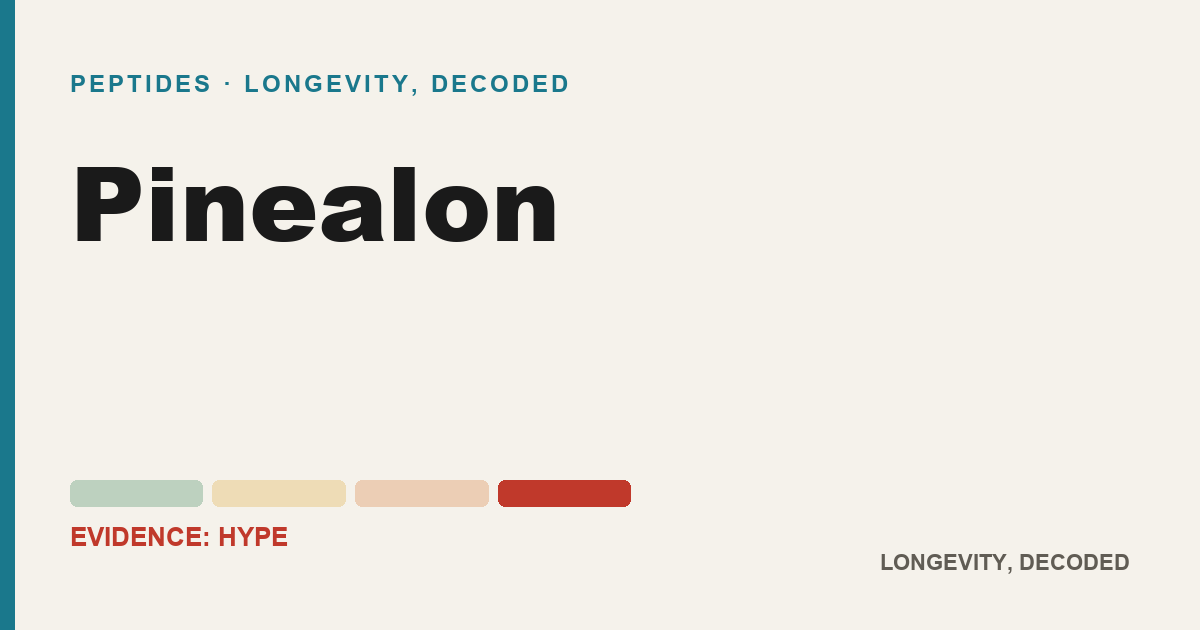
Evidence rating: Thin / Hype. Little or no human evidence; popular mostly on testimonials.
Pinealon is an intriguing lab-and-animal story sold as a brain-aging solution it has not earned. Without independent human evidence, it sits firmly in the speculative column, and any use belongs under medical supervision.
What is Pinealon?
Pinealon is another tiny synthetic peptide of Russian origin, this one just three amino acids long. It belongs to a family its developers call “peptide bioregulators,” and it is marketed mainly for the brain. Like Epitalon, it is a Russian-origin research peptide with no FDA approval in the United States and no broad approval elsewhere; its human evidence base is small and comes largely from the same research tradition.
What does Pinealon claim to do?
Pinealon is pitched as a brain-and-cellular-aging peptide:
- Protects neurons (brain cells) from stress and damage
- Sharpens memory, focus, and mental clarity
- Supports healthy daily rhythms and sleep
- Slows aging-related decline at the cellular level
Why do people use Pinealon?
It is usually sold as a companion to Epitalon, the “brain” peptide to Epitalon’s “clock” peptide, and the two are often bundled in longevity stacks. The appeal is straightforward: anyone worried about memory and mental sharpness with age finds a neuron-protecting peptide attractive, especially when it is cheap and easy to obtain.
What does the science actually say about Pinealon?
The pattern should feel familiar by now. Pinealon’s claims rest on laboratory work and animal studies, mostly from the same Russian research lineage that produced Epitalon. In cell and animal models, peptides like this have been reported to protect neurons from certain stresses and to influence how genes behave. Those are interesting signals.
But signals in cells and rodents are the very beginning of the evidence ladder, not the top. Independent, well-controlled human trials showing that Pinealon improves memory, protects the aging brain, or extends healthy life are absent. The leap from “protected neurons in a dish” to “keeps your mind young” is enormous, and no robust human data bridges it. When the same small group of researchers produces most of the supporting studies and outside labs have not confirmed them, the right posture is skepticism, not excitement.
How do people use Pinealon?
In experimental use it is injected in short courses, sometimes paired with Epitalon, with doses drawn from the older literature rather than from controlled human studies. This is described here only as information about what people report doing. No sourcing or self-administration guidance is provided.
Is Pinealon safe? Risks and who should skip it
Human safety data, especially long-term, is thin to nonexistent, the core reason for caution. Anything marketed to act on the brain and gene activity warrants extra care. Pregnant or nursing people, anyone with a neurological condition, and anyone on medication should not experiment without a doctor. As always with unregulated peptides, contamination and mislabeling are genuine risks.
The bottom line on Pinealon
Pinealon is an intriguing lab-and-animal story sold as a brain-aging solution it has not earned. Without independent human evidence, it sits firmly in the speculative column, and any use belongs under medical supervision.
Frequently asked questions about Pinealon
Does Pinealon actually work?
Neuroprotective claims rest on lab and animal work from a narrow research base, with no robust independent human trials supporting the brain-aging benefits.
Is Pinealon safe?
Human safety data, especially long-term, is thin to nonexistent, the core reason for caution. Anything marketed to act on the brain and gene activity warrants extra care.
How do people use Pinealon?
In experimental use it is injected in short courses, sometimes paired with Epitalon, with doses drawn from the older literature rather than from controlled human studies. This is described here only as information about what people report doing.
Related in Peptides
Medical disclaimer: This article is for general information only and is not medical advice, a recommendation, or an endorsement. Nothing here is intended to diagnose, treat, cure, or prevent any disease. Talk to a qualified healthcare professional before changing anything you do. See our full disclaimer.