Fadogia Agrestis
Gut, Metabolic & Hormonal · Supplements
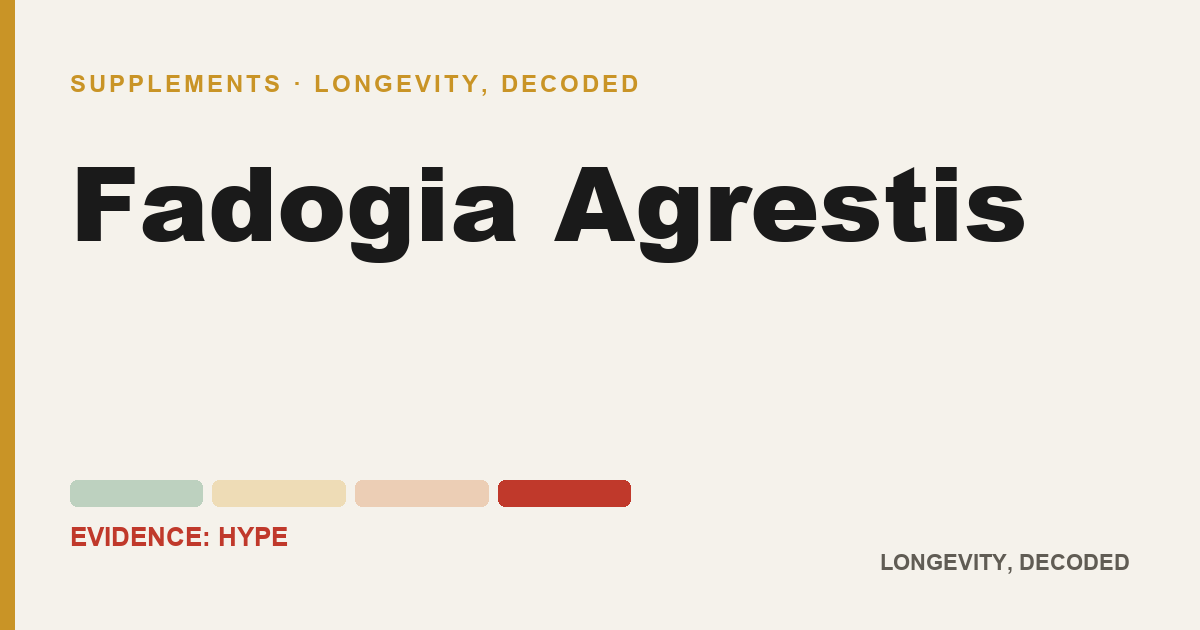
Evidence rating: Thin / Hype. Little or no human evidence; popular mostly on testimonials.
Fadogia is a striking example of hype racing far ahead of evidence: human data is essentially nonexistent, and the animal studies behind the hype also flagged possible toxicity. This is one to be genuinely cautious about, if you are tempted, talk to a doctor first and understand you are the experiment.
What is Fadogia Agrestis?
Fadogia agrestis is a shrub native to West Africa, used traditionally in Nigeria, whose stem extract is sold as a testosterone and libido booster, almost always alongside Tongkat Ali. It surged in popularity after being mentioned in podcast and biohacker circles. It is important to be blunt up front: this is one of the least-studied supplements in this entire book, and most of what is claimed about it comes from a small number of animal experiments, not human research.
What does Fadogia Agrestis claim to do?
Sellers and enthusiasts claim it raises testosterone, boosts libido and sexual performance, increases energy and drive, and supports muscle and athletic performance. It is positioned as a potent “natural” hormone optimizer, frequently stacked with Tongkat Ali for a combined vitality effect.
Why do people use Fadogia Agrestis?
Its rise is almost entirely a product of social-media and podcast buzz. The promise of a natural, non-prescription testosterone lift is powerful, and Fadogia got swept up in the same vitality-optimization wave as Tongkat Ali. Many people take the two together simply because that is how they are marketed and discussed, without realizing how different their evidence bases are.
What does the science actually say about Fadogia Agrestis?
This is where the honesty has to be loudest. The often-repeated claim that Fadogia “raises testosterone” traces back primarily to rodent studies, most prominently work in male rats showing increased testosterone and sexual behavior at certain doses. That is genuinely interesting as a starting point, but it is animal data, and it does not establish that the same thing happens, safely, in humans. There are essentially no quality human trials demonstrating the benefits people take it for.
Just as important, the same animal research that gets cited for benefits also raised a serious red flag: at higher doses, signs of testicular toxicity and organ stress appeared in the rats. So the very studies people lean on for the upside also hint at potential harm, and we lack the human data to know where the safe line is, or whether there is one for chronic use.
There is no established safe dose, no long-term human safety record, and no reliable picture of what daily use does to the liver, kidneys, or hormones over time. Combine that with an unregulated supplement market where purity and accurate dosing are not guaranteed, and the result is a product that is popular far out of proportion to what is actually known about it.
How do people use Fadogia Agrestis?
People commonly take 300–600 mg of extract daily, usually cycled a few weeks on and off, and often stacked with Tongkat Ali. This is worth stating plainly: these doses and schedules come from community convention and extrapolation from animal work, not from human safety research. There is no validated protocol.
Is Fadogia Agrestis safe? Risks and who should skip it
This is the riskiest item in this part, and the caution is real, not boilerplate. Animal data raised concerns about testicular and organ toxicity at higher doses, and human safety is simply unknown. Product quality and purity in this unregulated space are not guaranteed. Given all that, many people are better off skipping it entirely. Anyone considering it should involve a doctor, and it should be avoided by those who are pregnant, breastfeeding, trying to conceive, or managing any heart, liver, kidney, or hormonal condition.
The bottom line on Fadogia Agrestis
Fadogia is a striking example of hype racing far ahead of evidence: human data is essentially nonexistent, and the animal studies behind the hype also flagged possible toxicity. This is one to be genuinely cautious about, if you are tempted, talk to a doctor first and understand you are the experiment.
Frequently asked questions about Fadogia Agrestis
Does Fadogia Agrestis actually work?
Human evidence is essentially absent; the hype rests on a handful of rat studies that also flagged potential toxicity.
Is Fadogia Agrestis safe?
This is the riskiest item in this part, and the caution is real, not boilerplate. Animal data raised concerns about testicular and organ toxicity at higher doses, and human safety is simply unknown.
How do people use Fadogia Agrestis?
People commonly take 300–600 mg of extract daily, usually cycled a few weeks on and off, and often stacked with Tongkat Ali. This is worth stating plainly: these doses and schedules come from community convention and extrapolation from animal work, not from human safety research.
Related in Supplements
Medical disclaimer: This article is for general information only and is not medical advice, a recommendation, or an endorsement. Nothing here is intended to diagnose, treat, cure, or prevent any disease. Talk to a qualified healthcare professional before changing anything you do. See our full disclaimer.