Nature / Forest Bathing
Mind & Nervous System · Foundations
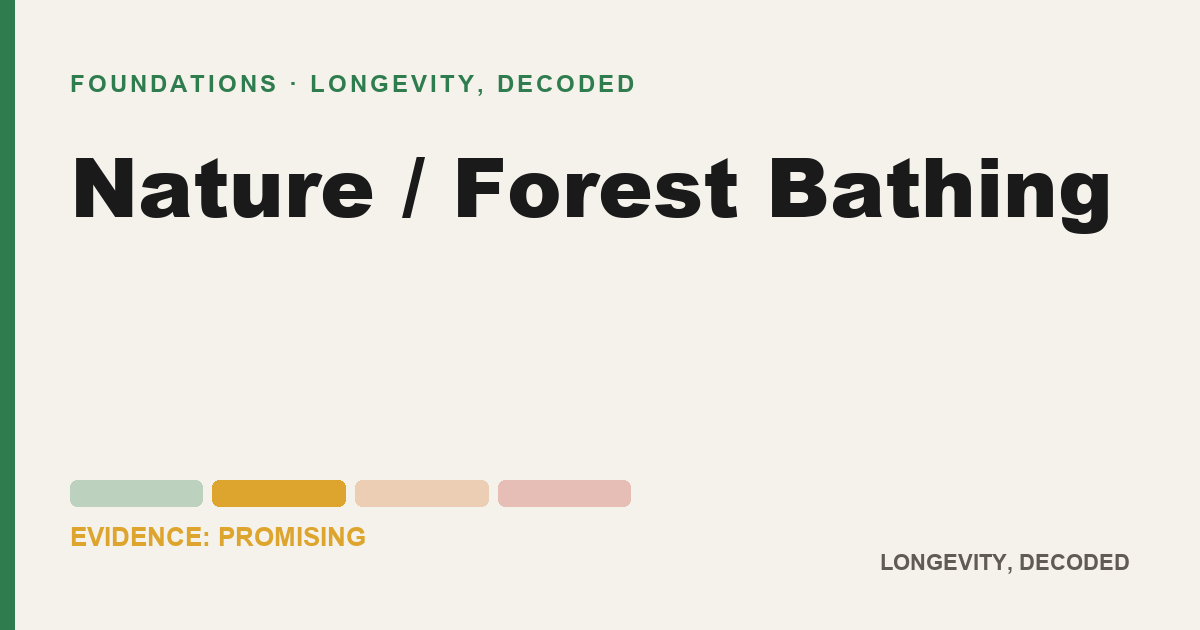
Evidence rating: Promising. Early human data or a strong mechanism, not yet conclusive.
Time in nature is cheap, safe, pleasant, and genuinely associated with lower stress and better mood, one of the easiest wins in this entire book. Don't overthink the mystical immune claims; just go outside regularly and slowly.
What is Nature / Forest Bathing?
Forest bathing is the English name for shinrin-yoku, a Japanese practice that translates literally to “taking in the forest atmosphere.” Despite the name, no water or bathing is involved. You simply spend slow, unhurried, screen-free time among trees, paying attention to what you see, hear, and smell. More broadly, “nature exposure” covers any deliberate time spent in green or natural spaces (parks, woods, coastlines, even a leafy walk) with the explicit goal of unwinding.
What does Nature / Forest Bathing claim to do?
Proponents say time in nature lowers stress hormones, drops blood pressure and heart rate, lifts mood, sharpens attention, and strengthens immune function. A specific and much-repeated claim is that breathing in compounds released by trees (called phytoncides) boosts your “natural killer” immune cells. Bigger picture, advocates point to research linking people who live near green space with longer, healthier lives.
Why do people use Nature / Forest Bathing?
It’s free, pleasant, and requires zero equipment or expertise. You just go outside. In a culture drowning in screens and indoor air, the idea that the cure for modern frazzle is a walk in the woods is deeply appealing. Forest bathing has been formalized into guided programs in Japan and beyond, but most people simply adopt it as permission to slow down outdoors without a destination or a step count.
What does the science actually say about Nature / Forest Bathing?
The everyday version of this claim is on solid ground. A large and growing body of research links time spent in natural settings with lower stress and better mood. Controlled studies comparing a walk in nature to an equivalent walk in a city repeatedly find that the nature walk is associated with lower self-reported stress, reduced rumination (the mental loop of churning over problems), and improvements on attention tests. Some studies suggest nature exposure may support modest short-term reductions in blood pressure and stress-hormone levels. The effect is gentle but consistent.
The population-level evidence is striking too: people who live in greener neighborhoods tend, on average, to report better health and well-being. These are observational studies, so they can’t prove green space itself is the cause (greener areas may differ in wealth, air quality, and a dozen other ways) but the link holds up across many countries and is hard to dismiss.
The most-cited specific claim, about tree compounds boosting natural killer immune cells, comes from a small group of studies, mostly from a handful of Japanese researchers and often with few participants. The findings are intriguing and the mechanism is plausible, but it has not been widely replicated, so treat the “trees boost your immune system” headline as an early, single-lab lead rather than settled science. Happily, the broad stress and mood benefits don’t depend on it.
How do people use Nature / Forest Bathing?
There’s no protocol to get wrong. People aim for at least 20 minutes in a natural setting, ideally without a phone or a fitness goal, several times a week. Researchers studying the “dose” often point to roughly two hours a week in nature, in any combination, as a sweet spot associated with well-being. Forest bathing emphasizes slowness: walk gently, pause, and engage your senses rather than racking up distance.
Is Nature / Forest Bathing safe? Risks and who should skip it
About as low-risk as a treatment gets. The usual outdoor common sense applies: sun protection, allergy awareness in pollen season, ticks in wooded areas, appropriate footwear, and staying within your physical limits on rough terrain. There’s essentially no one who should skip spending pleasant time outdoors, though anyone with serious allergies or mobility limits should choose their setting accordingly.
The bottom line on Nature / Forest Bathing
Time in nature is cheap, safe, pleasant, and genuinely associated with lower stress and better mood, one of the easiest wins in this entire book. Don’t overthink the mystical immune claims; just go outside regularly and slowly.
Frequently asked questions about Nature / Forest Bathing
Does Nature / Forest Bathing actually work?
Consistent human evidence that nature time is associated with lower stress and better mood; the specific immune-boost claim is early and under-replicated.
Is Nature / Forest Bathing safe?
About as low-risk as a treatment gets. The usual outdoor common sense applies: sun protection, allergy awareness in pollen season, ticks in wooded areas, appropriate footwear, and staying within your physical limits on rough terrain.
How do people use Nature / Forest Bathing?
There's no protocol to get wrong. People aim for at least 20 minutes in a natural setting, ideally without a phone or a fitness goal, several times a week.
Related in Foundations
Medical disclaimer: This article is for general information only and is not medical advice, a recommendation, or an endorsement. Nothing here is intended to diagnose, treat, cure, or prevent any disease. Talk to a qualified healthcare professional before changing anything you do. See our full disclaimer.